

Just under a couple of years ago, I posited the question: how can anyone really be confident that Ferrari's marquee signing, Lewis Hamilton, will be a definite upgrade on Carlos Sainz when time rolls around to make the switch?
The argument against this was laid out in the column was, in truth, a slightly detuned version of itself, just out of a worry of coming off as contrarianism-for-clicks amid the excitement over the Hamilton-to-Ferrari move - which had well transcended the Formula 1 sphere.
But 2024, in which Hamilton demonstrably ceded ground to George Russell in the intra-Mercedes battle, had only made the case stronger. And yet what transpired the following year, after a glitzy, hype-y launch of a championship onslaught and all the talk of Hamilton's reinvigoration, seemed to come as a shock.
Ferrari certainly didn't live up to its end of the bargain. The SF-25 started out shaky, was swiftly abandoned as a potential title vehicle and seemed to only summon naked derision off the track - and untold snaps and spins on the track - from the two drivers by the end of the season. The two drivers were afforded some goodwill, too, by chairman John Elkann's strange decision to go public with criticism of their focus.
But Hamilton and the Ferrari race team around him seemed to struggle with the reality of his match-up with Charles Leclerc even outside of any of that context. This piece by my colleague Samarth Kanal documented it well - from the deliberately hushed answers in a range only elephants could hear to the dramatism of the words that did get picked up, Hamilton so often sounded like he was being obliterated by his team-mate. In truth, for most of the year he was just being beaten, not destroyed.
Sainz himself had been beaten, not destroyed, in his time with Leclerc. Though in the aftermath he took a bit of time to find his feet at Williams, any suggestion he had been 'upgraded' upon at Ferrari seems fanciful for now.
The question instead has to be: did Ferrari weaken its line-up, and if so by how much?
There is no empirical way to definitively answer that, not the least because Leclerc's level as the benchmark isn't necessarily a constant and because we have a four-year sample size versus Sainz and just one versus Hamilton - but here are three metrics to at least try to get an idea.
The points
The simplest way to look at things is the points standings. Leclerc's 86-point buffer over Hamilton in 2025 is actually the furthest ahead he's been compared to a team-mate since 2017 - when he was racing in Formula 2 and running up the score against now-Ferrari F1 tester Antonio Fuoco.
Obviously that's deceptive. The cars Leclerc has driven in F1 have been of a very varied points-scoring capability, the points system has had its changes, the calendar has grown.
So let's do a percentage comparison instead.
2021: Sainz scored 101.5% of Leclerc's points
2022: Sainz scored 79.9% of Leclerc's points
2023: Sainz scored 97.1% of Leclerc's points
2024: Sainz scored 81.5% of Leclerc's points
2025: Hamilton scored 64.5% of Leclerc's points
Hamilton was at a very respectable 86.6% of Leclerc's points at the halfway mark in the season, but the slide in the second half of the campaign was a dramatic one, coinciding with a general downturn in the upgrade-less Ferrari's performances.
Leclerc and his results clearly reflected it too, but he still dug out seven top-five finishes in the same 12-round timespan (including three podiums), compared to just the one for Hamilton.
The qualifying
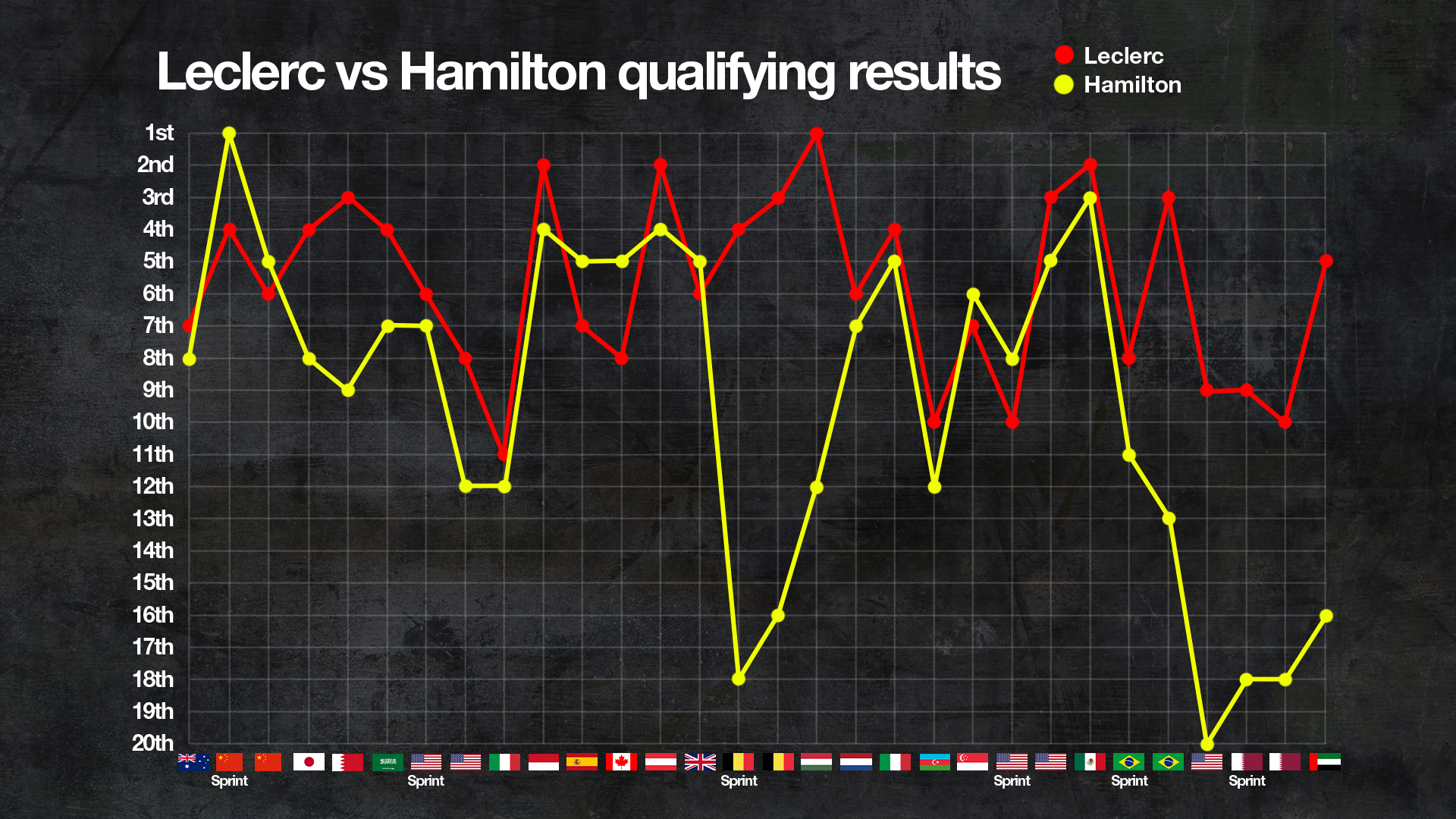
This was always the area in which Hamilton would be expected to struggle the most against Leclerc - and an area in which Sainz was an underrated strong foil for the Monegasque.
Sainz was at 32-57 versus Leclerc in the qualifying head-to-head. Taking grand prix qualifying only, Hamilton went 5-19 versus Leclerc this year.
His deficit, though, was no outrageous outlier (at least if you discount the weather-skewed Las Vegas qualifying).
2021: Sainz 0.083s slower
2022: Sainz 0.125s slower
2023: Sainz 0.189s slower
2024: Sainz 0.037s slower
2025: Hamilton 0.178s slower
Axing sprint qualifyings from the 2025 calculation gets the number to a downright sensible 0.143s, which is still notable but not prohibitive.
But in the realities of this year's F1 and this year's Ferrari that deficit could often mean the difference between Q2 and Q3 or even Q1 and Q3, and thus fundamentally diverging weekend paths.
The race position
Fundamentally, this reflected itself in Leclerc and Hamilton spending their races in battles for different positions - to a much greater extent than had happened in the Leclerc-Sainz seasons.
Hamilton's famed stint management prowess, which had so often come to his rescue in ground effect-era Mercedes weekends in which Russell had the one-lap upper hand, just didn't really look like an obvious strength relative to Leclerc, save for an early-season flash in the China sprint win.
In the later rounds, it was increasingly difficult to make anything of Hamilton's race pace given he would spend so much time in traffic due to the grid positions Ferrari's decline (and his own deficit to Leclerc) was leaving him in.
Average race position (at the end of every GP lap)
2021
Leclerc: 6.3
Sainz: 6.7
2022
Leclerc: 3.6
Sainz: 3.8
2023
Leclerc: 5.2
Sainz: 5.5
2024
Leclerc: 4.8
Sainz: 5.0
2025
Leclerc: 5.0
Hamilton: 7.6
Across the four years, Sainz was 0.33 behind Leclerc on average race position. It's 2.65 for Hamilton.
Being blunt
There is simply no case to be made that Hamilton has been replicating Sainz's on-track production, much less eclipsing it.
Ferrari's end-of-season backslide, in a field that has occasionally all slotted in within a second or less over one lap, has almost certainly made things look worse than they really are. But things are not good.
It may change with the rule reset in 2025. But right now both parties have grounds to feel short-changed.
But while Ferrari's collapse was difficult to foresee given the strength of its late-2025 form, Hamilton's form against Leclerc was hardly outside of the range of expected outcomes.
Elkann's reaction suggested it caught Ferrari off-guard, and the way Hamilton trudged through the season made it clear he hadn't expected it, too.
But they all should have. And they may need to recalibrate their expectations together, lest 2026 prove more miserable still.